Guides · Cedar Key, Florida
Cedar Key Buildings: Reading the Pencil Mill Town's History
Augustus Steele paid $227 for the military structures on Atsena Otie Key in 1843. With them came 167 acres and a name that would define the town before it existed. Atsena Otie is the Creek language's phrase for cedar island, and the cedar gave the entire group of keys its name. The island became the nucleus of the first organised settlement in the Cedar Keys. What happened there in the decades that followed was an industrial boom so complete that the town's remaining buildings are the only way to read its scale now.
Atsena Otie: The Cedar Island That Named the Town
Steele's purchase in 1843 was not the founding of a town so much as the acquisition of a location. The military structures he bought were the only improvements on the island, and the 167 acres that came with them were mostly wilderness. But the name he kept—Atsena Otie, cedar island—was the key to everything. The cedar that grew there and across the nearby keys was not ornamental. It was the raw material for a product the world could not get enough of: the pencil. The island's high ground, where more than thirty-five houses would later survive the 1896 storm surge, was the first place in the Cedar Keys where people built permanent homes. The town that grew around it was a company town before the companies arrived.
Cedar Key's Pencil Mills: How Cedar Became Slats
The Eberhard Faber mill, set up in 1865, was the first major operation. It cut red cedar slats for pencils, and the scale of the trade is difficult to grasp from the quiet streets of today's town. By 1886, seventeen sawmills at Cedar Key were turning out nearly half a million board feet of lumber a week. The Eagle Pencil Company also cut pencil slats here, alongside Faber, and the product was the same: thin, straight-grained cedar slats that could be shipped north, grooved, filled with graphite, and turned into pencils. This was not a local craft industry. Cedar Key supplied the wood the world wrote with. The mills did not cut timber for houses or furniture; they cut pencil slats and pencil boxes, and the buyers were the two great pencil manufacturers of the era. The town was not a port that happened to have mills. It was a manufacturing centre whose entire reason for existing was the cedar.
The 1896 Hurricane: The Storm That Ended the Pencil Era
The 1896 hurricane did not merely damage the mills. It damaged them so badly that both the Eberhard Faber mill and the Eagle Pencil Company closed soon after. The storm surge, which locals still call "the tidal wave," swept across the keys, and a fire followed the water. The combination was fatal to the industry. The mills were not rebuilt. The pencil companies did not return. The cedar was depleted, the infrastructure was wrecked, and the market moved on. The town did not die, but the industry that had made it a place of national importance was over in a single season. The 1896 hurricane is not one Gulf storm among many in the town's memory. It is the dividing line between the industrial town and the one that exists now.
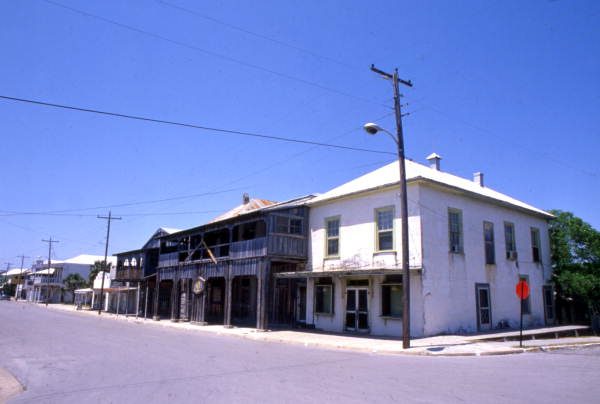
Cedar Key Historic Buildings: What Survives from the Mill Era
The physical evidence of the pencil era is sparse but legible. The Eagle Pencil Company site on Way Key at 3rd and G Streets is the most accessible remnant. The site is not a preserved museum; it is a place where the mill once stood, and reading it correctly means seeing the ground as industrial land rather than empty lots. On Atsena Otie Key, the houses on high ground that survived the 1896 surge are more than thirty-five in number, and they are the clearest proof that the island was a settled community before the storm. These are not mansions. They are the houses of mill workers and their families, built on the only ground high enough to escape the water. The fact that they survived the tidal wave is a structural record of where the island's safe ground was.
Cedar Key Today: A Town Smaller Than Its History
The census numbers tell the story of the aftermath. Cedar Key has a population of 756 people, with a median age of 68.4 years. Of the 819 total housing units, 450 are vacant and 269 are held for seasonal or recreational use. The median home value is $331,100, and the median gross rent is $918. The unemployment rate is 4.2 percent, and 49.7 percent of residents hold a bachelor's degree or higher. The median household income is $69,226. These figures describe a town that is smaller than its history. The industrial peak of the 1880s supported a workforce measured in the thousands; the town now holds fewer than eight hundred residents, and more than half of its housing stock is empty or seasonal. The buildings that remain from the milling era are not numerous, but they are the only way to measure the difference between what the town was and what it is.
Cedar Key Seafood Festival: A Day to See the Islands
The Cedar Key Seafood Festival, run by the Lions Club each October, is the annual event that brings the islands back to life. It features more than 100 arts and crafts exhibits, live music, a Saturday parade at 11am, and clam chowder, oysters, and smoked mullet dip. It is also the rare chance to reach Seahorse Key, a historic island three miles out that is otherwise closed to the public. The festival is not a reenactment of the milling era. It is a contemporary gathering that happens to take place on the same water that the mills used. For a visitor, it is the best way to see the islands in a single day, and the boat trip to Seahorse Key is a reminder that the islands were the point of the town, not the town itself.
| Cedar Key Then and Now: The Numbers Behind the Story | |
|---|---|
| Then (1886/1896) | Now (Census) |
| 17 sawmills, nearly half a million board feet a week | 756 residents |
| Eberhard Faber mill established 1865 | Median age 68.4 years |
| Eagle Pencil Company cutting slats and pencil boxes | 450 vacant housing units out of 819 |
| 1896 hurricane and fire close both mills | 269 seasonal or recreational housing units |
| More than 35 houses survive the tidal wave on Atsena Otie Key | Median home value $331,100 |
Common questions
- What happened to the pencil mills in Cedar Key?
- The Eberhard Faber mill and Eagle Pencil Company cut red cedar slats here until the 1896 hurricane and fire damaged both so badly they closed soon after. The Eagle site was on Way Key at 3rd and G Streets.
- Is Atsena Otie Key worth visiting?
- Atsena Otie Key is the island first settled, with more than thirty-five houses on high ground surviving the 1896 storm surge. It's historically significant, but access is limited—you can reach Seahorse Key during the October Seafood Festival, not Atsena Otie itself.
- How many people live in Cedar Key now?
- Cedar Key's population is 756 people, with a median age of 68.4 years. There are 819 housing units, but 450 are vacant, and 269 are for seasonal or recreational use—so the year-round community is small.
- What's the best time to visit Cedar Key?
- October's Cedar Key Seafood Festival is a highlight: over 100 arts and crafts exhibits, live music, a Saturday parade at 11am, and clam chowder, oysters, and smoked mullet dip. It's also your rare chance to reach Seahorse Key, normally closed.
- Why is Cedar Key historically important?
- Cedar Key supplied the wood the world wrote with—17 sawmills by 1886 turned out nearly half a million board feet a week, feeding pencil makers like Eberhard Faber and Eagle. The town's name comes from the cedar that grew on Atsena Otie Key.
- What's the economy like in Cedar Key today?
- Median household income is $69,226, with unemployment at 4.2%. Median home value is $331,100, and median gross rent is $918. Nearly half of residents (49.7%) hold a bachelor's degree or higher, reflecting a well-educated but small population.
Every business named above is one we hold a listing for, and every date traces to a source on our sources page. We do not describe menus, interiors or service we have not verified. Details change — confirm before you travel.